Was Switching to Fujifilm the Right Decision?
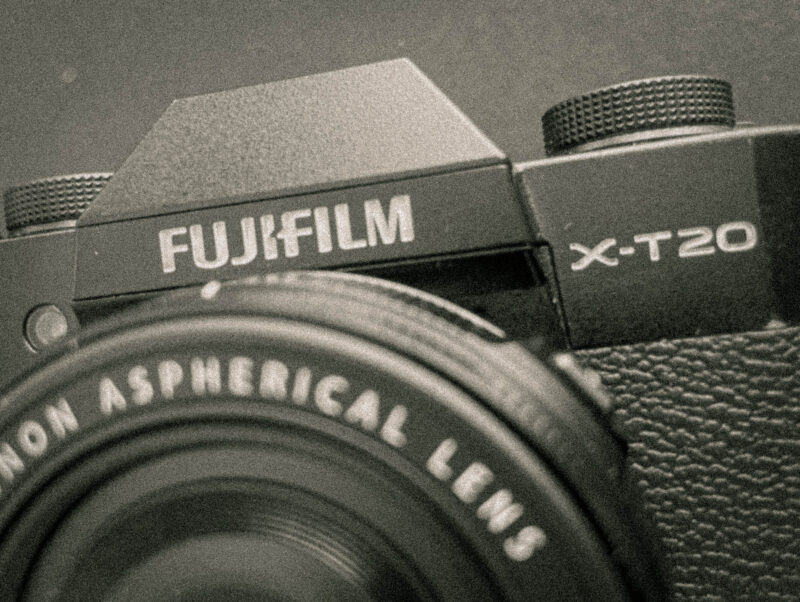
Was Switching to Fujifilm the Right Decision?
After spending some time with the Fujifilm X-T20 and the XF 23mm f/2.8 R WR, I feel I’ve finally reached some conclusions.
This isn’t a review of the lens, nor is it a technical comparison between Fujifilm cameras or film simulation recipes. It’s simply my experience of moving from Canon to Fujifilm and learning to understand a completely different way of approaching photography.
Although I’m writing about the X-T20, I think most of these thoughts apply to the Fujifilm system as a whole. This isn’t about specifications or comparing one camera with another. It’s about how the camera feels to use, how it encourages you to photograph, and whether its philosophy matches the way you see the world.
I’ve been interested in photography for many years. I studied Multimedia, where I learned both film and digital photography, and over time I’ve photographed everything from family events to professional work. Although architectural visualisation has been my main profession, photography has always been an important part of my life.
For that reason, I hope these thoughts may be useful to anyone thinking about changing camera systems. If you’re considering moving from Canon, Sony, or another brand to Fujifilm, you may have some of the same questions I had before making the switch.
Looking back, I think I made my decision a little too quickly.
Not because Fujifilm is better or worse than Canon, but because the two systems have very different philosophies. That’s something you only begin to understand after living with the camera for a while.
In the following pages, I’ll share what surprised me, what disappointed me, what eventually won me over, and how my opinion gradually changed as I became more familiar with the Fujifilm way of photographing.
Why did I decide to change systems?
As I mentioned in an earlier article, my decision to change cameras wasn’t driven by image quality.
My main goal was to find a camera that was lightweight, compact, portable, affordable, and offered interchangeable lenses and a viewfinder—all without compromising image quality.
Those requirements came from the way I like to travel. Whether I’m cycling across Europe or spending the day with my family, I wanted a camera that I could carry everywhere without it becoming a burden. A camera that’s always with you is far more valuable than one that’s left at home because it’s too heavy or inconvenient.
In reality, my Canon already met most of those requirements. So that raises an obvious question.
Why did I decide to change systems?
The biggest reason for changing cameras was actually quite simple.
My Canon didn’t have a viewfinder, and over time I realised that it was a feature I genuinely missed. I wanted the option of composing my photographs through an electronic viewfinder, especially when shooting outdoors in bright sunlight.
At the same time, I had become increasingly curious about the Fujifilm system. I had read a lot about its unique approach to photography, its film simulations, and the experience that so many photographers seemed to enjoy. I also knew that Fujinon lenses had an excellent reputation for image quality.
After comparing several options, the X-T20 stood out as the camera that ticked all the boxes. It was compact, lightweight, offered interchangeable lenses, included a viewfinder, delivered excellent image quality, and, just as importantly, allowed me to keep my investment relatively low.
In many ways, it seemed like the perfect camera for the kind of photography I enjoy and the way I like to travel.
My Disappointments!
If I had to point out the biggest disappointment after switching to Fujifilm, it wouldn’t be the camera itself. It would be the way I expected to use film simulation recipes.
When I bought the camera, I imagined that film recipes would become an important part of my photography. After all, they’re one of the features that make Fujifilm unique and attract so many photographers to the system.
After living with the camera for a while, however, I realised that they didn’t really fit the way I work.
The first limitation I found was the way custom recipes are managed inside the camera. Personally, I don’t find it very practical to organise and switch between different presets depending on what I’m photographing. It means remembering to load a specific profile before every session, and that simply doesn’t suit the way I like to work.
More importantly, I realised that film recipes don’t really fit into my photographic workflow.
I’ve been using Lightroom for many years, and almost every photograph that matters—whether it’s for personal projects or professional work—ends up being edited there. The only images that usually remain untouched are the casual family photographs that go straight into our personal albums.
Because I don’t use social media, I don’t have the need to produce images that are immediately ready to share straight out of the camera. Every photograph is transferred to my computer or phone anyway, so if I ever want a particular look, it’s just as easy to apply it later during editing.
For my way of working, I never found a practical reason to build my photography around pre-defined film recipes.
Another aspect that surprised me was Fujifilm’s colour rendering.
Coming from Canon, and having also used Sony over the years, I immediately noticed that Fujifilm has its own very distinctive interpretation of colour. The reds tend to be more pinkish, the greens feel stronger and drier, and the blues often appear deeper and more saturated.
The Fujifilm Red

This isn’t a criticism—it’s simply Fujifilm’s colour philosophy, and many photographers love it.
Personally, though, I never completely connected with the way Fujifilm renders reds. They were probably the colours that took me the longest to accept and adapt to.
Should I Change Systems Again?
No, I don’t think that’s something I’ll be worrying about any time soon.
Everything I’ve mentioned in this article can be worked around. The camera is reliable, produces excellent image quality, and is perfectly capable of meeting my needs. The rest is simply part of the editing process.
Whenever I’m photographing something important, I always shoot in RAW. Over the years I’ve developed my own Lightroom workflow, including a custom import preset that gives me a starting point much closer to the look I prefer. From there, every image becomes part of my normal editing process, just as it always has.
Because of that, I see no reason to change camera systems again.
The final image quality that I get from the X-T20 and the XF 23mm f/2.8 R WR is excellent. The files contain an impressive amount of detail, and the camera has proved itself more than capable of producing photographs that I’m genuinely happy with.
So, after reading everything I’ve shared, you might be wondering…
Would I switch from Canon to Fujifilm again?
I already know what my answer would be.
But that’s my answer, based on my experience, my workflow, and the way I see photography.
Your answer may be completely different—and that’s exactly as it should be.
There isn’t a perfect camera system.
There is only the one that best fits the way you like to photograph.
So, What Settings Did I Finally Settle On?
After many experiments, countless adjustments, and a lot of trial and error, I think my conclusions are now quite clear.
For the time being, I’ve decided to keep my Fujifilm set up like this.
These aren’t necessarily the perfect settings, nor do I believe they’ll be the ones I use forever. They’re simply the settings that currently best suit the way I photograph and the workflow I’ve developed over the years.
As with everything in photography, that may change in the future. But for now, this is the setup I’ll be using over the coming weeks.
This is a fairly flat and neutral profile that gives me a solid starting point for editing.
It preserves as much flexibility as possible, allowing me to develop each image later in Lightroom according to the look I’m trying to achieve, rather than committing to a strong in-camera style from the beginning.
| Setting | Value |
|---|
| Film Simulation | ASTIA / SUAVE |
| White Balance | Auto ( R2 B-2 ) |
| Dynamic Range | Auto |
| Highlight | -2 |
| Shadow | -2 |
| Colour | -2 |
| Sharpness | 0 |
| Noise Reduction | -2 |
| Grain Effect | Off |
| RAW + JPEG | Yes |
Below are a few photographs I took yesterday in Nazaré using these settings.
Alongside each image, on the right I’ve included a version edited with one of my Lightroom presets. The intention isn’t to compare which one is “better,” but simply to show my usual workflow.
For me, the camera captures the image, while Lightroom allows me to refine it and create the final look I’m aiming for.








Want to Try My Lightroom Preset?
If you’ve enjoyed the look of the photographs in this article and would like to try the Lightroom preset.
Let me know in the comments.
If there’s enough interest, I’ll make it available for download.
I’d Love to Hear Your Thoughts
Have you ever switched camera systems?
Did you have a similar experience, or was it completely different?
Feel free to leave a comment below and share your thoughts. I’d genuinely enjoy hearing about your experience.
You Might Also Be Interested In
My new, Fujifilm “X-T20” 10 years old in 2026
Berlin, Black & White
Was Switching to Fujifilm the Right Decision?
My “Camera Bag” sistem for bikepacking,
Deixe um comentário